

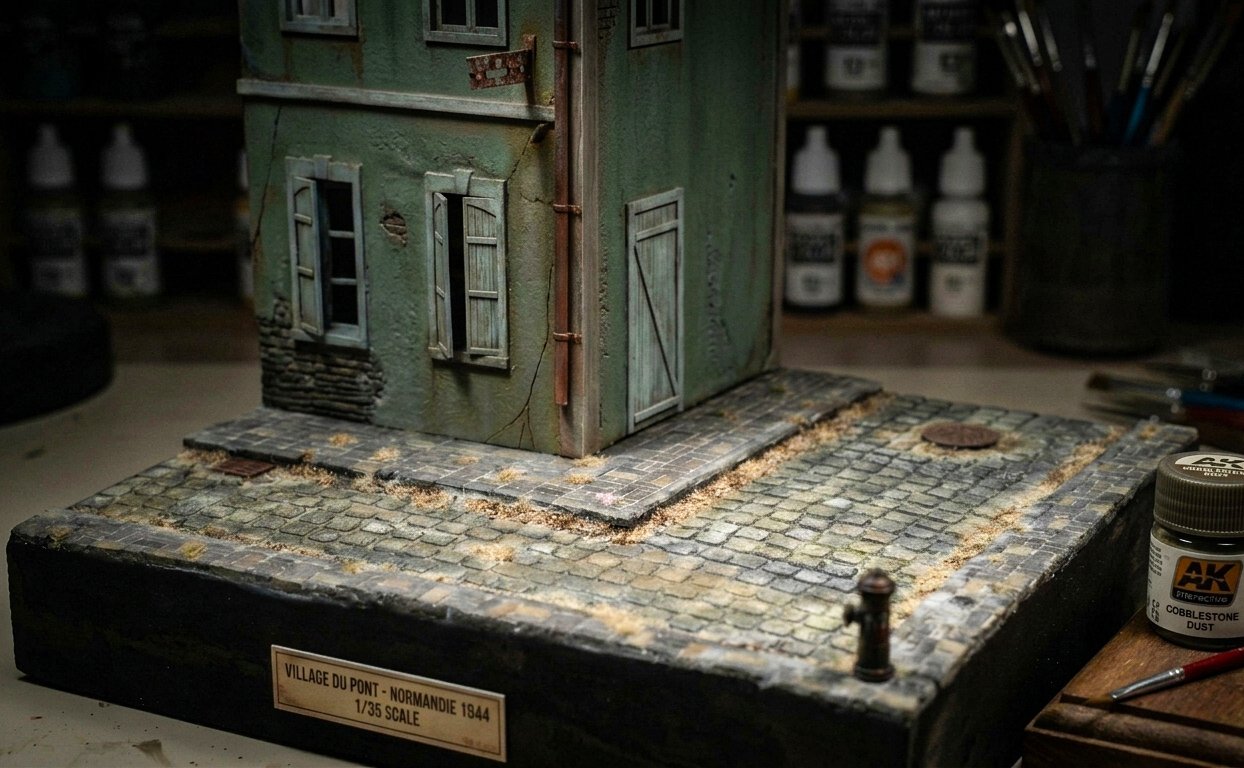
A diorama is more than a base with a model sitting on it. For me, the fun starts when all the little elements begin working together to tell a story. In this build, we’re heading to the Colmar Pocket and creating a WWII scene where the terrain, road, structures, details and weathering all have to feel like they belong in the same place.
Watch the Complete Build
Watch Crafting a Realistic Diorama: The Colmar Pocket on YouTube →
Building the Scene, Not Just the Base
Before getting lost in tiny details, the first job is establishing the composition. Roads, walkways, buildings, terrain and the main model all need enough space to breathe while still directing your eye through the scene.
This is one of those stages where moving something a few centimeters can make a surprisingly big difference. Glue is permanent. Staring at the layout for another five minutes is free. 😁
Creating the Groundwork
The groundwork gives the entire diorama its foundation. Different textures help separate travelled areas from sidewalks, damaged ground and the softer terrain around them. Small changes in height and surface texture prevent the base from looking perfectly flat and artificial.
Roads, Walkways and Cobblestones
Hard surfaces are a huge part of the character of this scene. Rather than treating the road or walkway as one flat color, build variation into the individual stones and surrounding surfaces. Greys, earth tones, washes and subtle highlights help create depth without making every stone scream for attention.
Wear and dirt should also follow the story of the scene. Areas exposed to traffic, rubble and weather won’t look exactly the same as protected corners.
Details Make the Difference
This is where the scene starts coming alive. Drain and sewer details, debris, damaged surfaces, vegetation and other small elements break up the larger areas and give the viewer something new to discover.
You don’t need fifty accessories fighting for attention. A few well-placed details usually tell the story better than emptying the entire spare-parts box onto the base. Tempting… but no. 😁
Bring Everything Together With Weathering
Weathering isn’t only for the vehicle. The same dust, dirt, moisture and environment should affect the road, structures and surrounding terrain. Repeating related tones throughout the scene is one of the easiest ways to visually connect all the separate pieces.
The Story Is the Final Detail
Historical dioramas become much more interesting when the modeling supports a place and a moment rather than simply displaying a finished kit. The Colmar Pocket provides the historical setting, but the textures, damage, positioning and little handmade details are what turn that setting into a scene.
And that is always the goal around here: don’t just build the model — build the world around it.
Want more Scale Wonderland? Subscribe to the Scale Wonderland YouTube channel for more WWII modeling, diorama, weathering and scratch-building projects. You can also join me on Patreon for cheat sheets, WIP photos, behind-the-scenes content and member extras.
Every Model Tells a Story!